oil on canvas
1917
lower right
55 × 38 cm
framed
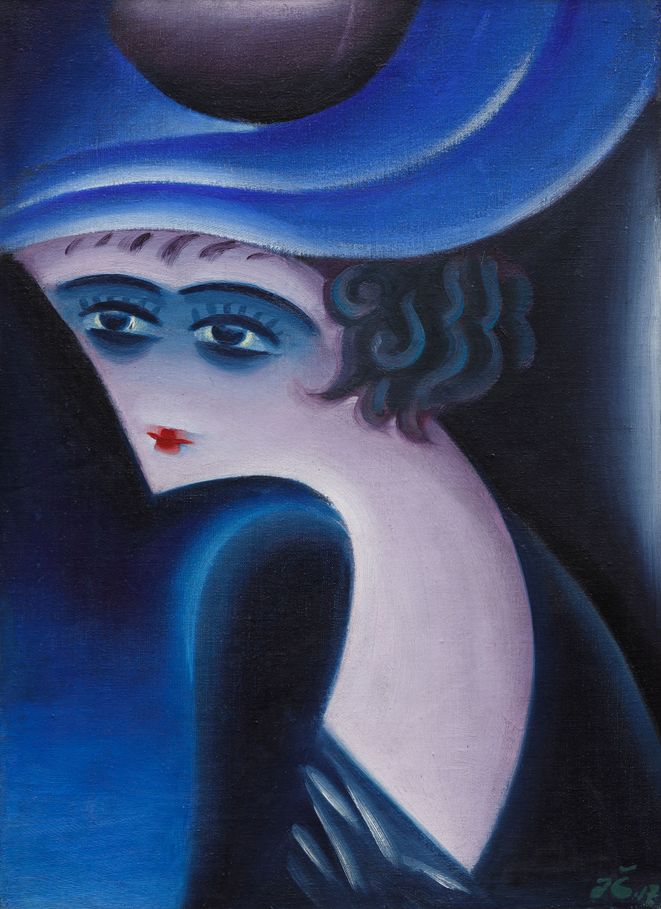
Harlot / Two Children by Josef Čapek, one of the most important painters of the first half of the twentieth century, represents a truly unique opportunity for collectors. The work is part of Čapek’s expressive cycle of oil paintings dating from World War I, in which he dealt with figures from the urban underworld. At the time, he deepened his interest in the inner life of people, engaging with social issues such as drunks, prostitutes and beggars. As in the cycles Girls and Will-o’-the-Wisps, he captured female figures with bewitching, almost unsettling expressions that represent a counterweight to the chaste and delicate girls from the Toilette cycle. Čapek did not create snapshots of a genre in these paintings, but a symbolic study of human types, whose physiognomy expressed the psychological and existential form of the human being.
Harlot depicts a mysterious woman in a hat, who gazes at the viewer with wide blue eyes. The swan-like silhouette of her neck gracefully echoes the shape of her sumptuous hat. In this context, she represents a darker form of femininity, associated with challenge and disaffection. Čapek mentioned similar girls with bewitching eyes in an article about Kees van Dongen’s exhibition in the Bernheim-Jeune Gallery in Paris. According to him, the painter “does not paint in the field of reality, but in the field of passion, against purple and black backgrounds, as they emerge from imaginary darkness in sharp, provocative colors and as they gaze forth from the canvas with black, mostly sorrowful, haunting eyes” (J. Čapek, “Z Paříže. Výstava van Dongenova u Bernheima,” Přehled 9, 1910–1911, no. 38, p. 576).
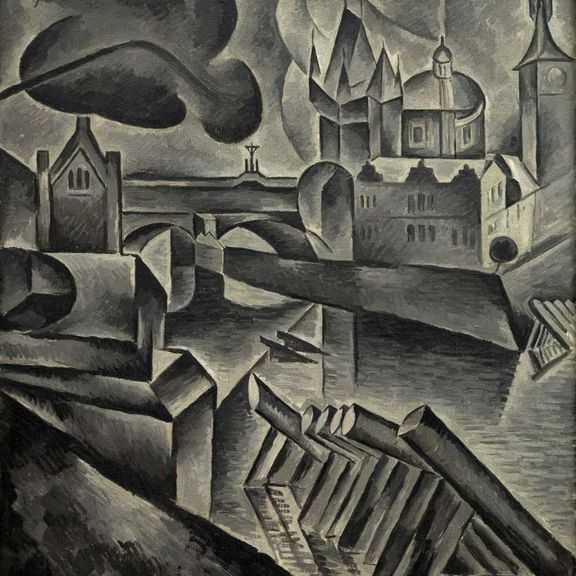
The reverse side of the canvas features the Cubist painting Two Children, which recalls Čapek’s firm anchoring in the modernist explosions of the pre-war period. The linking of both sides reflects the artist’s ongoing search for expressive possibilities: from analytical Cubism to an expressive and symbolic grasp of the human figure. The collector’s value of this painting is increased by its provenance in the celebrated collection of JUDr. Jaroslav Borovička, in which this painting, along with Bohumil Kubišta’s Old Prague Motif, was among the most important works. While Kubišta’s painting hung in the bedroom, Čapek’s oil hung over the desk, with the side featuring Two Children displayed. The painting was held for a long time by the National Gallery in Prague (inv. no. O 8103), and was exhibited many times. It is included in an inventory of Čapek’s art works (P. Pečinková: Pracoval jsem mnoho, Soupis výtvarného díla Josefa Čapka, díl třetí, Humpolec: Malba, 2023, p. 642, cat. no. III/124). Assessed in consultation with Prof. J. Zemina and PhDr. R. Michalová, Ph.D. The expert opinion of PhDr. P. Pečinková, CSc. is attached: “[...] The listed work was created after World War I, in a key phase of Čapek’s artistic career, when he had fully evaluated his Parisian experience and arrived at a distinctive and unmistakable artistic position inspired by the principles of Cubism and Black art, i.e., magical realism. [...].”