Bohumil Kubišta (1884–1918)
Bohumil Kubišta ranks among the founders of Czech modern painting and is one of the most significant figures in Czech art at the turn of the twentieth century. After studying at the Academy of Arts, Architecture and Design and later at the Academy of Fine Arts in Prague under Vlaho Bukovac, he joined the newly established artistic association Osma (The Eight) in 1907. Its members included Emil Filla, Bedřich Feigl, Max Horb, Otakar Kubín, Willi Nowak, Emil Artur Pittermann and Antonín Procházka, later joined by Vincenc Beneš, Linka Scheithauerová-Procházková, Václav Špála and others. As the first Czech proponents of French Fauvism and Cubism, as well as German and Nordic Expressionism, the members of Osma positioned themselves in opposition both to academic art and to the preceding Czech artistic generation of the 1890s. A decisive shared inspiration for the group was Edvard Munch’s exhibition in Prague in 1905. For Kubišta, however, Osma served above all as an intellectual platform. As its most rigorous theorist, he articulated the group’s artistic programme in exhibition reviews and influential essays, arguing that the work of art possessed a spiritual and philosophical dimension that extended far beyond formal experimentation alone. It was precisely on this point that his views increasingly diverged from those of Filla, for whom form and its autonomous development represented the primary focus of artistic enquiry.
During two stays in Paris (1909 and 1909–1910), Kubišta became acquainted with the work of Paul Cézanne and with the Proto-Cubist approaches of Pablo Picasso and Georges Braque. Together with Filla and Procházka, he thus became one of the first pioneers of Cubism in the Czech lands. For Kubišta, however, Cubism remained a means rather than an end in itself. He believed that painting possessed an inherently spiritual essence and that, through an understanding of the laws governing artistic creation – including the study of colour theory, complementary and simultaneous contrasts, the golden ratio, and the work of the Old Masters from El Greco and Delacroix to Vincent van Gogh – it was possible to arrive at a profound insight into the nature of the world. He understood the expressive power of colour as a form of mystical symbolism, interpreting the opposition between red and green as an emblematic confrontation between life and death.
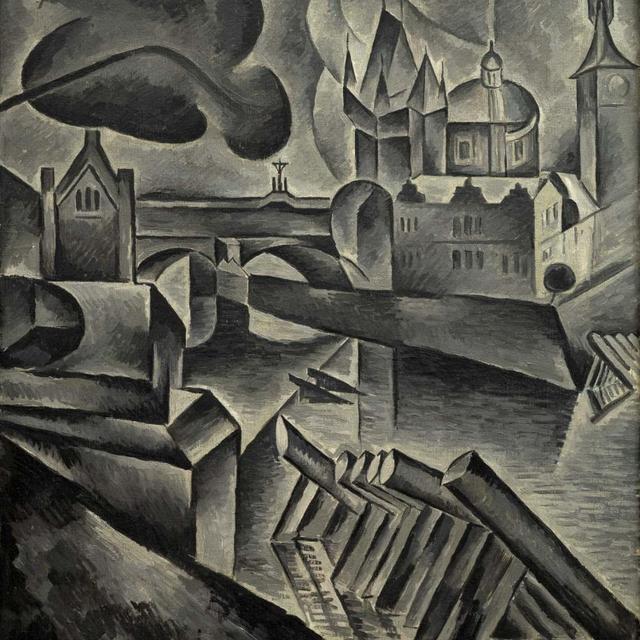
Through the geometric language of Cubist forms, Kubišta sought to reinterpret religious subjects and to reveal spiritual forces beyond the reach of ordinary perception. Works such as Saint Sebastian (1912) and The Hypnotist (1912) exemplify this approach, as do paintings depicting the confrontation of life’s fundamental opposites, including The Raising of Lazarus (1911–1912), Still Life with a Skull, and The Kiss of Death. Even apparently conventional subjects such as landscapes and still lifes were conceived as spiritual dramas. The intellectual and formal synthesis of this vision is embodied in Old Prague Motif (1911), a painting in which the analytical fragmentation of objects and their subsequent reintegration within the pictorial surface achieve extraordinary coherence. Through its characteristic “supernatural” luminosity, Kubišta sought what he termed penetrism – a process of penetrating through the layers of visible reality towards its spiritual essence. In 1911 he established contacts with the German Expressionist group Die Brücke and developed close ties with the occult-inspired Czech group Sursum. Both affiliations testify to the profoundly spiritual and international orientation of his work.
After joining the army in 1913 and being posted to Pula in present-day Croatia, Kubišta’s palette became noticeably brighter, reflecting a renewed affinity with Fauvism. At the same time, wartime subjects such as Coastal Guns in Action against the Fleet (1913) and Air Raid on Pula (1914) demonstrate his growing interest in the Futurist depiction of movement and dynamic energy. His painting Meditation moved beyond both Cubist and Fauvist principles, approaching the threshold of Surrealism.
Kubišta died of Spanish influenza on 27 November 1918, not yet thirty-five years old. He left behind more than 120 oil paintings and pastels, a substantial body of graphic work, and an extensive corpus of theoretical writings on art, securing his place as one of the indispensable figures of Czech modern culture.
Items of the author
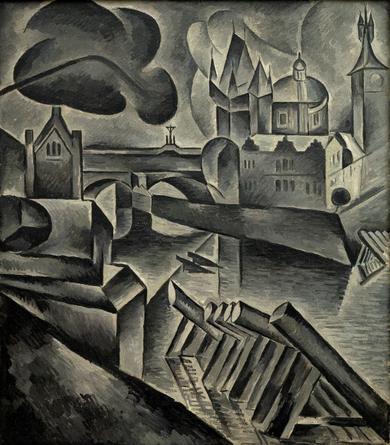
40,000,000 – 80,000,000
25,000,000 CZK
Final price:
123,600,000 CZK
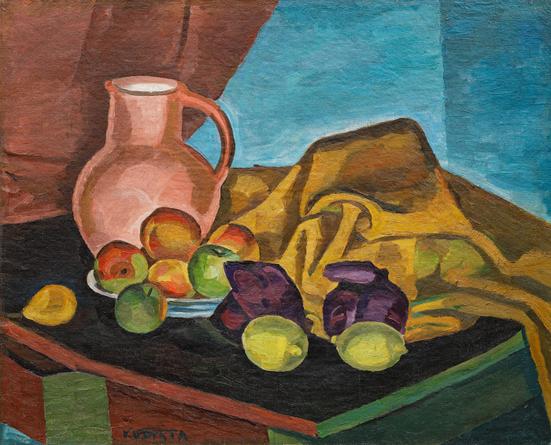
18,000,000 CZK
Final price:
23,520,000 CZK
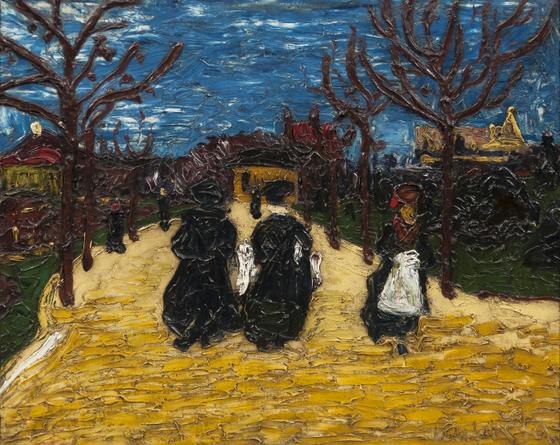
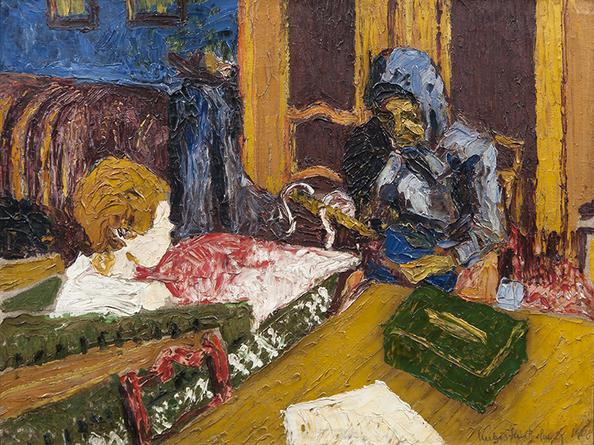
9,000,000 CZK
Final price:
13,920,000 CZK
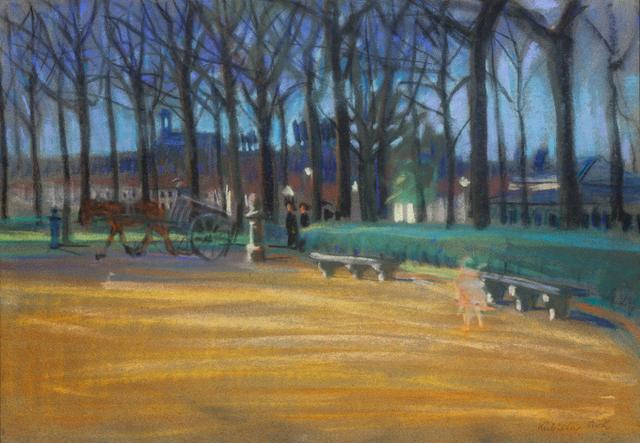
1,000,000 – 2,000,000
800,000 CZK
Final price:
1,320,000 CZK