mixed media (oil, sand) on canvas
1929
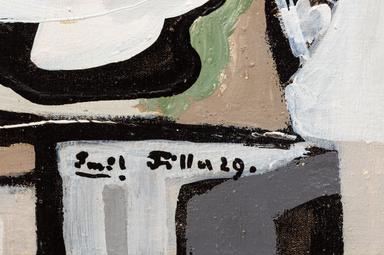
lower right
54 × 65 cm
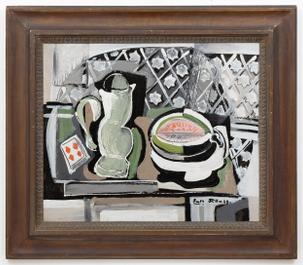
framed
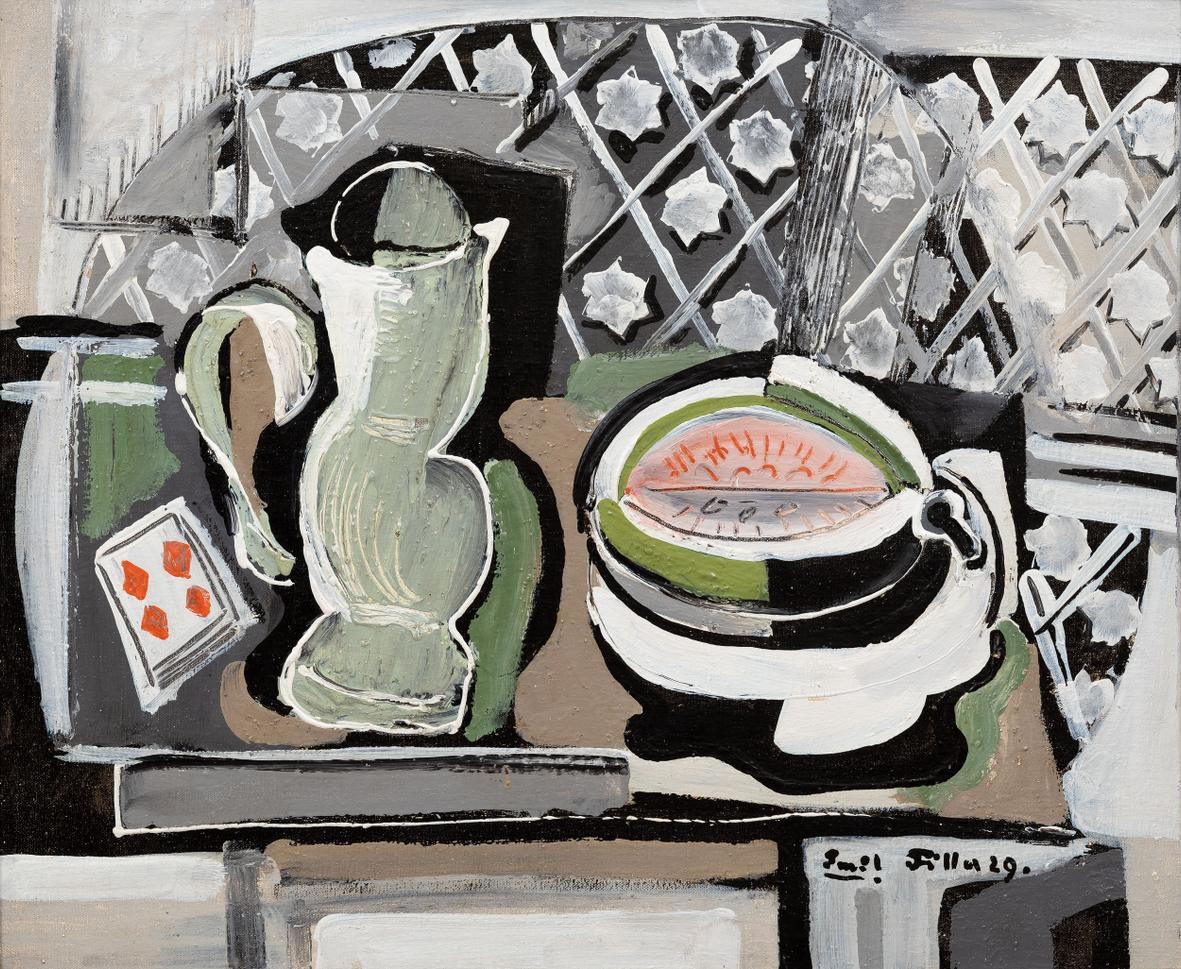
Still Life with Watermelon is among the finest examples of Emil Filla’s work from the late 1920s, a period during which he synthesised his Cubist foundations with a newly acquired sense of mass, relief-like modelling and the tangible concreteness of objects. The composition is structured according to a firm, almost architectural order, in which individual objects – a jug, a sliced watermelon and a pack of playing cards with the four of diamonds placed on top – become carriers of both formal and symbolic tension.
Particularly characteristic is Filla’s use of a thick impasto layer of paint, through which he modelled volumes while simultaneously emphasising the material quality of the painting itself. Here, he abandoned the analytical fragmentation of early Cubism in favour of more compact forms and clearly defined contours. Although the objects remain stylised, they retain their legibility and physical presence. Equally typical is the restrained and harmoniously balanced colour palette – muted greens, greys and ochre tones complemented by the accent of the watermelon’s red flesh and the playing cards – which both anticipated and further developed tendencies that would culminate in Filla’s celebrated white still lifes.
The decorative background, with its rhythmically structured ornament, reflects his long-standing interest in the synthesis of fine and applied art, as well as in the principles of folk and archaic modes of expression. The work as a whole thus presents a carefully considered balance between order and expression, between structural construction and painterly spontaneity.
This painting was created during Filla’s artistic maturity, when he ranked among the most prominent figures of the Czech interwar avant-garde. Still lifes of this kind represent an important contribution to the post-war European transformation of Cubism and demonstrate the artist’s ability to renew and reinterpret the language of modernism in relation to both reality and tradition.
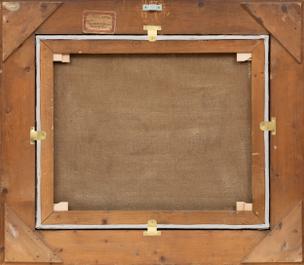
The significance of the work is evidenced by its inclusion in the Jubilee Exhibition of the Work of Emil Filla at the Mánes Association of Fine Artists in Prague in May 1932 (cat. No. 146), as confirmed by the stamp on the reverse of the canvas. It was also reproduced in the journal Musaion (vol. 2, No. 1, 1931, p. 72, under the title Still Life) and appears in a black-and-white photograph by Josef Sudek in Filla’s original catalogue raisonné. The first owner was Jaroslav Novotný, a pulmonary specialist at the Na Pleši sanatorium, a member of the Mánes Association and a friend of avant-garde artists.
The authenticity of the work has been verified by the Filla Foundation, and the painting will be included in the forthcoming catalogue raisonné. During consultations, the work was assessed by Prof. J. Zemina and PhDr. K. Srp. An expert opinion of Mgr. T. Mátl Donné is attached.