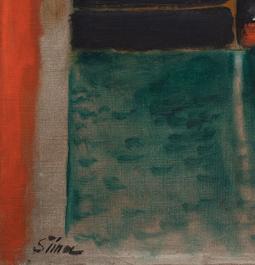
oil on canvas
1923
lower left
94.5 × 98 cm
framed
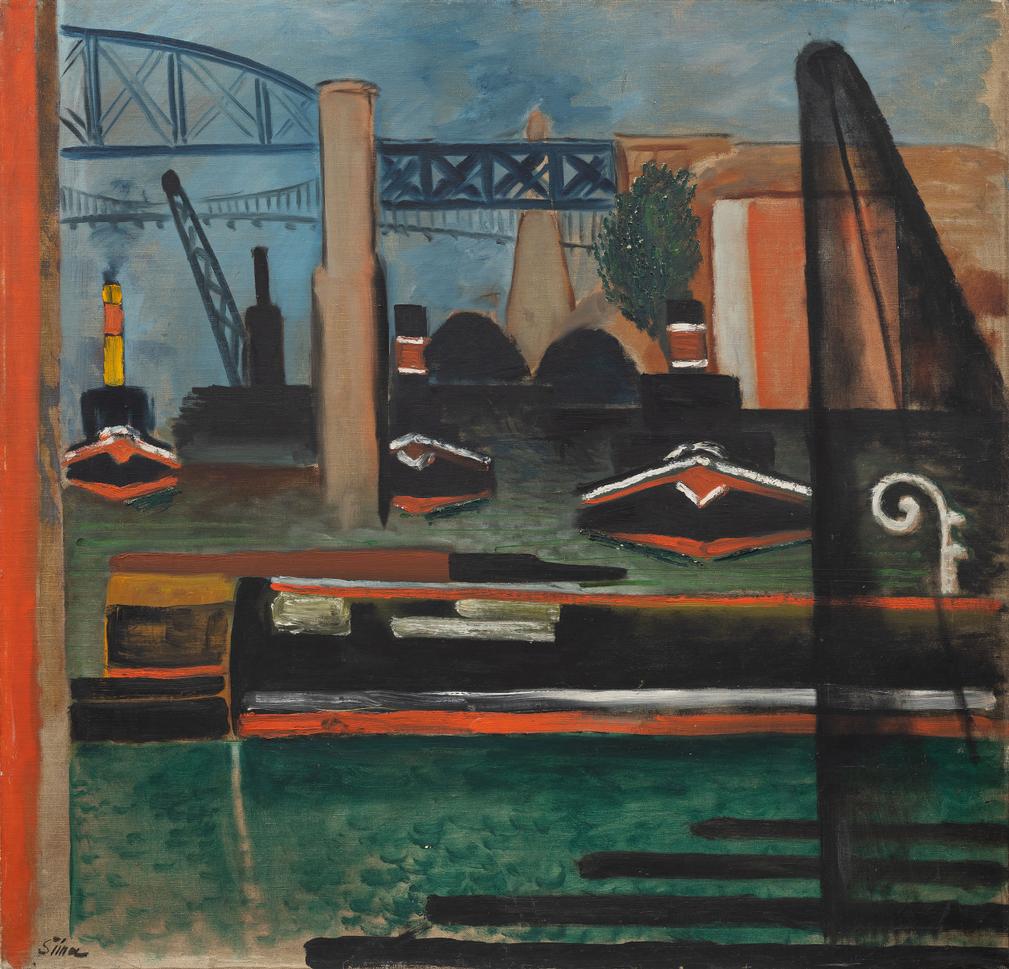
The painting Conflans St. Honorine (Conflans Fin d’Oise) was created during a brief but formative period, when Josef Šíma was transforming from a painter whose activities had until then been centred primarily in Brno into an artist whose life and work would remain inextricably linked with France. His journey to Paris, however, was not a direct one. He first left Brno for Hendaye, in south-western France near the Spanish border, where he found employment as a draughtsman of church stained-glass windows. He arrived in Paris on 19 October 1921 and, after a few weeks, found a home in the house of Louise-Denise Germain, whose sought-after bookbinding studio specialising in fine art books opened doors for him to writers, bibliophiles, visual artists and figures from the Parisian fashion world. It was there that he also met her daughter Nadine, his future wife. He familiarised himself with the city through frequent walks along the Seine, among warehouses, workshops, harbours and tugboats, while also absorbing the vibrant atmosphere of Montparnasse, exhibitions and Salons, as well as the new ideas he encountered in the circles of Auguste Perret, Georges Ribemont-Dessaignes and other prominent figures in the artistic life of the time.
Even after settling in Paris, Šíma maintained close ties with the Czech cultural milieu. In the summer of 1922, he met Karel Teige and Jaroslav Seifert there, who had arrived as representatives of Devětsil, the Czech avant-garde group for which he became one of the principal intermediaries in Paris. This was followed by collaborations with the journals Disk, Pásmo and Stavba. His own work thus developed alongside his direct engagement with Parisian artistic life and the transformation of the Czech avant-garde, which was then turning its attention towards the metropolis, technology and new conceptions of modernity. In 1922–1923, steamships and harbours on the Seine became some of Šíma’s principal subjects. They featured in a group of works that, alongside the paintings Paris, Harbour (Bassin de la Villette), Tugboats and Boats in Harbour, also included Conflans St. Honorine – a port town situated twenty-five kilometres downstream from Paris, at the confluence of the Seine and the Oise, and one of the principal centres of French inland navigation. It was here that his experience of the modern world was transformed into a distinctive painterly language. Šíma combined a bright palette influenced by Fauvism with a firm geometric order, while allowing the latter to remain subordinate to the freedom of his brushwork. He never used a ruler; his ‘freehand geometry’ lends even the most rigorously constructed compositions a sense of improvisation and spontaneous creation.
Within this group of works, Conflans St. Honorine occupies an exceptionally important position. Here, the harbour motif perhaps moves furthest beyond a mere record of modern life, beginning to reveal principles that would persist in Šíma’s painting long after ships and cranes had disappeared from it. The composition of the canvas, disrupted only by the diagonals of the ships’ bows and the curves of the bridge structures, holds the entire scene in a state of tension between stillness and activity. Where the heavy machinery above the water seems to lose its material substance, and the deep black of the hulls, funnels and harbour walls detaches itself from the objects it describes to become an independent horizontal band rhythmically organising the picture surface, one can already discern Šíma’s interest in the threshold between a real object and its sign. A similar shift is suggested by the colour combination of black, white and red, which runs through this group of paintings as a leitmotif, appearing on the bows of the steamships.
Šíma’s approach is not an apotheosis of the mathematical beauty of mechanical forms, but rather a distinctly lyrical, poetic celebration of contemporary life, foreshadowing the atmosphere of the emerging Czech movement of Poetism. By the turn of 1923–1924, his painting would move towards non-representational expression, with landscapes and natural formations replacing mechanical forms. Yet his fundamental way of thinking would remain unchanged: increasingly, a tangible object would serve as a gateway to what lies beyond its immediately visible appearance. In this sense, Conflans St. Honorine can be understood as one of the paintings in which Šíma discovered the ‘alphabet’ of his subsequent work. Its ships, funnels and harbour structures would later give way to eggs, crystals, trees uprooted from the earth and torsos suspended above the landscape.
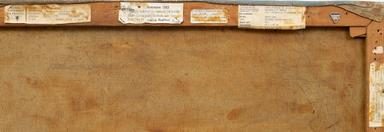
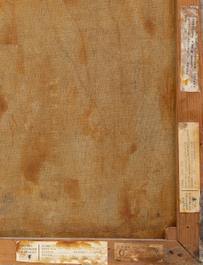
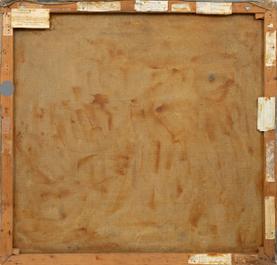
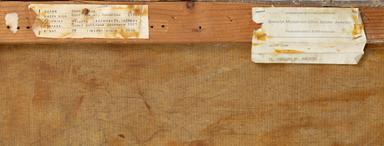
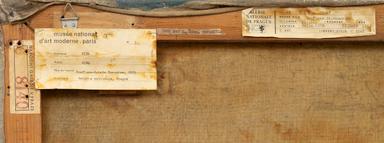
The painting originally belonged to the collection of JUDr. Jaroslav Borovička, from which it subsequently entered the collections of the National Gallery in Prague (inv. no. O 8140). Significantly, this canvas has repeatedly been selected from Šíma’s early work for his retrospective exhibitions and international surveys of Czech modern art. For decades, it has been regarded as one of the paintings that clearly demonstrate how the artist depicting the modern world developed his own distinctive and unmistakable visual language. The work was assessed during consultations with Prof. J. Zemina and Mgr. Ch. Zimová of the Josef Šíma Foundation. An expert opinion by PhDr. K. Srp is attached.
Reproduced in:
· V. Linhartová: Joseph Sima: ses amis, ses contemporains, Brussels, 1974, p. 76
· F. Šmejkal: Josef Šíma, Prague, 1988, p. 55, fig. 44
· F. Šmejkal: Joseph Sima, Paris, 1992, p. 55, fig. 44
Exhibited:
· Souborná výstava Josefa Šímy (1916–1925), Topič Salon, Prague, 4–22 March 1925, cat. No. 39 (Conflans fin d’Oise)
· Josef Šíma: Obrazy a kresby, National Gallery in Prague, 22 May – 23 June 1968; Slovak National Gallery, Bratislava, July–August 1968; Moravian Gallery in Brno, August–September 1968, cat. No. 10
· Joseph Sima, Musée national d’art moderne, Paris, 7 November – 30 December 1968, cat. p. 29, fig. 3
· Filla, Gutfreund, Kupka och tjeckisk kubism 1907–1927, Malmö Konsthall, 17 December 1982 – 6 March 1983, cat. No. 188
· Tsjechisch kubisme, Royal Museum of Fine Arts, Antwerp, 12 September – 15 November 1987, cat. No. 77
· Sixty Paintings from the Národní galerie, Prague, Solomon R. Guggenheim Museum, New York, 3 June – 11 September 1988, cat. No. 53
· Chefs-d’œuvre de la Galerie nationale de Prague. Grands maîtres de la peinture moderne, Musée du Québec, 1 October – 20 November 1988, cat. No. 51
· Josef Šíma, Prague Castle Riding School, National Gallery in Prague, 9 July – 13 September 1992, cat. No. 39