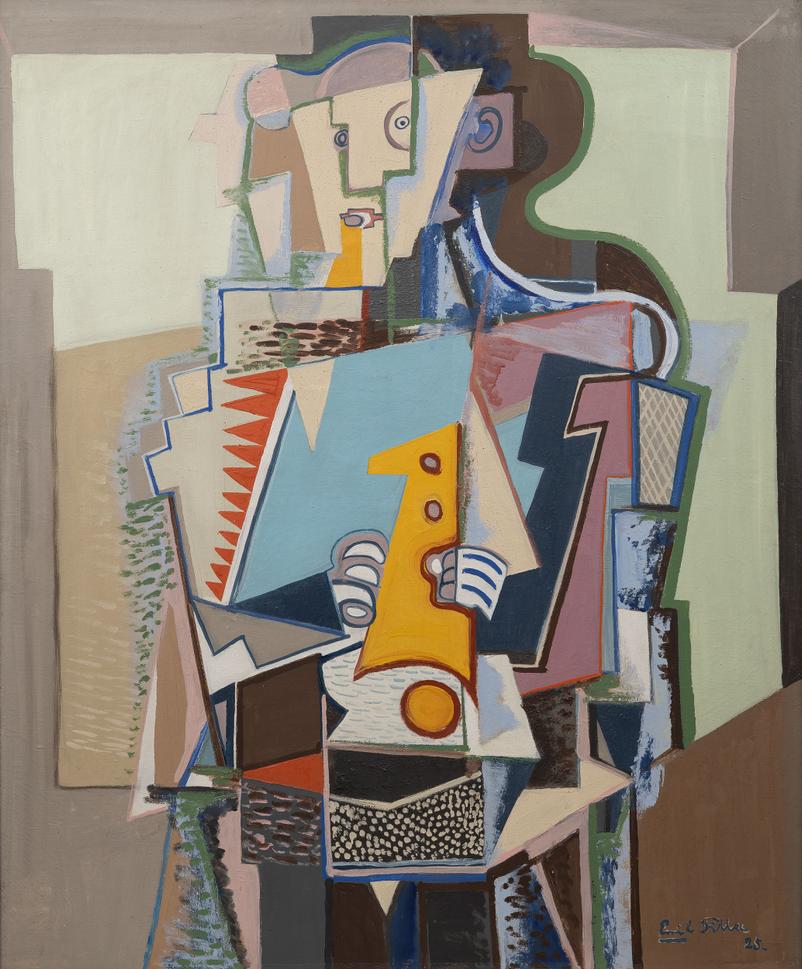
mixed media (oil, enamel, sand) on canvas
1925
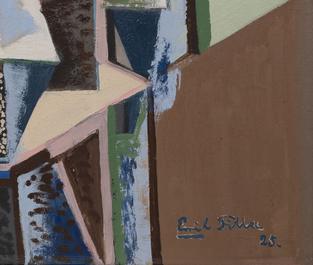
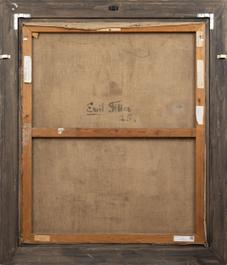
lower right, on the reverse
119 × 99 cm
framed
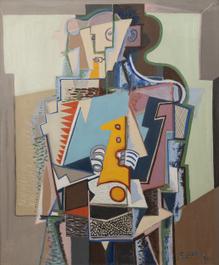
This monumental and exceptionally striking painting from 1925 is a representative example of Emil Filla’s interwar work, dating from a period when his Cubism was freeing itself from its immediate dependence on French models and acquiring an increasingly individual and painterly, more freely handled character. After returning to Prague in 1920 from more than six years of exile in the Netherlands, Filla re-engaged intensively with the domestic art scene and, during the first half of the 1920s, established himself as one of its leading figures. The year 1925 marked a significant milestone in his career. In February, his first solo exhibition opened at the Museum of Decorative Arts in Brno, conceived as a retrospective of his work from 1907 to 1924; in April, a joint exhibition of Emil Filla and Juan Gris followed at Galerie Alfred Flechtheim in Düsseldorf. By the mid-1920s, contemporary critics were increasingly recognising Filla’s independence. His former association with Pablo Picasso was receding into the background, giving way to his own painterly and chromatic virtuosity.
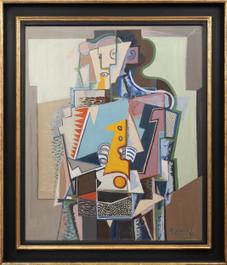
This transformation is also clearly evident in the presented work. A solid Cubist structure remains the foundation of the composition, but its geometric order is becoming more fluid, while colour, drawing and the very substance of the paint assume ever greater importance. Musician is constructed from overlapping planes, with sharp angles alternating with softer curves, while muted shades of pink, blue, green and brown are enlivened by striking yellow and orange accents. The richer palette characteristic of Filla’s work in the mid-1920s, together with the balance between refined colour and a lighter, freer approach to drawing, is particularly evident here. The combination of oil paint, enamel and sand further diversifies the surface of the canvas, enhancing its material presence and sensory impact.
Filla’s emancipation from French influences did not, however, mean a rejection of artistic tradition. On the contrary, he regarded it as a living source that could be reinterpreted through modern means. In 1925, he also published his essay Caravaggiovo poslání (Caravaggio’s Mission), which demonstrates his longstanding interest in the Old Masters and the history of European painting. In his Cubism, therefore, painterly experience, colour and the freedom to engage with tradition increasingly came to the fore alongside formal construction.
The presented Musician thus marks a stage on the path towards a more lyrical mode of Filla’s Cubism, which fully developed only towards the end of the 1920s. His ability to transform an adopted Cubist language into a distinctive form of expression with a powerful sensory and poetic resonance may be regarded as one of his most significant contributions to Czech interwar art.
The painting’s documented provenance further enhances its significance. It was held in the collections of the National Gallery in Prague under inventory No. O 8563, from which it was subsequently returned as part of the restitution process. A National Gallery label bearing the inventory number is still on the reverse, together with labels from exhibitions of Czech Cubism in Malmö and Antwerp. The painting is now in a distinguished Prague collection. Its authenticity has been verified by the Filla Foundation, and it is included in its online catalogue raisonné. The work was assessed during consultations with Prof. J. Zemina and PhDr. K. Srp. An expert opinion by Mgr. T. Mátl Donné is attached.
Reproduced in:
· J. Kotalík / P. Hartmann: Praha 1920–1940: Tšekkoslovakian taidetta = Tjeckisk konst, Ateneum Art Museum, Helsinki, 1988, p. 56
· V. Lahoda: Emil Filla, Prague, 2007, p. 429, fig. 464
· T. Mátl Donné: Emil Filla ze soukromých sbírek, Prague, 2026, p. 84
Exhibited:
· Jubilejní výstava díla Emila Filly, Mánes Association of Fine Artists, Prague, 29 April – 29 May 1932; exhibited but not listed in the catalogue
· Od Mánesa ke Špálovi, Regional Gallery in Liberec, 1 July – 1 August 1963, cat. No. 43
· Emil Filla: Obrazy a kresby z let 1906–1953, House of Arts, Zlín, 22 September – 10 November 1963, cat. No. 21
· Umění a doba: České umění dvacátých let, National Gallery in Prague, Waldstein Riding School, May–June 1971, cat. No. 14
· České malířství XX. století ze sbírek Národní galerie. Díl II., National Gallery in Prague, January–December 1973, cat. No. 201
· Filla, Gutfreund, Kupka och Tjeckisk kubism 1907–1927, Malmö Konsthall, 17 December 1982 – 6 March 1983, cat. No. 65
· Tsjechisch kubisme, Royal Museum of Fine Arts Antwerp, Antwerp, 12 September – 15 November 1987, cat. No. 31
· Praha 1920–1940: Tšekkoslovakian taidetta = Tjeckisk konst, Ateneum Art Museum, Helsinki, 25 August – 2 October 1988, cat. No. 14
· Emil Filla ze soukromých sbírek, Galerie KODL, Prague, 24 June – 21 August 2026, cat. No. 23