oil on canvas
before 1910
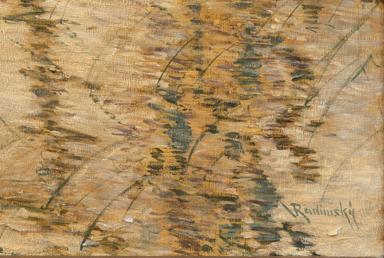
lower right
103.5 × 129 cm
framed
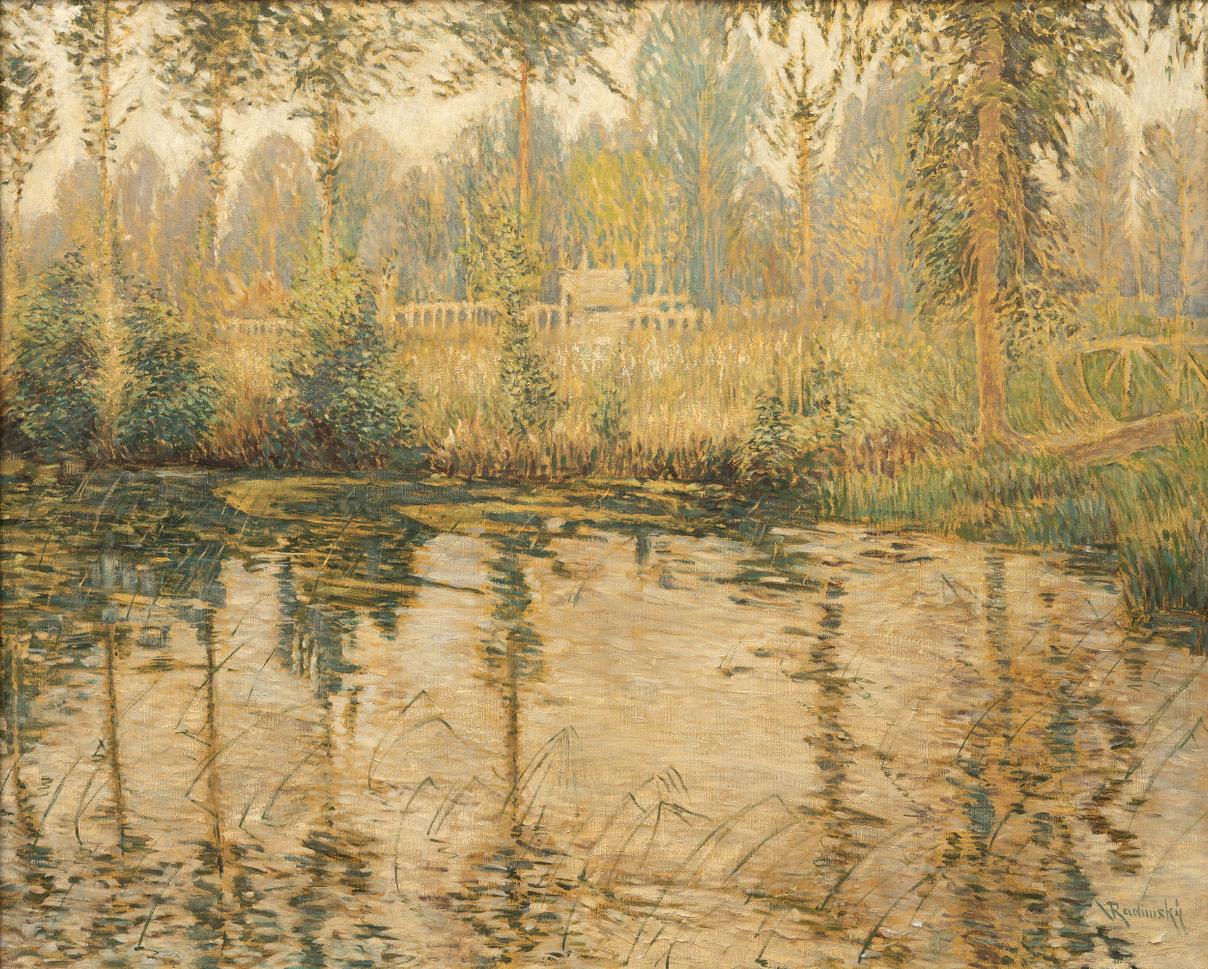
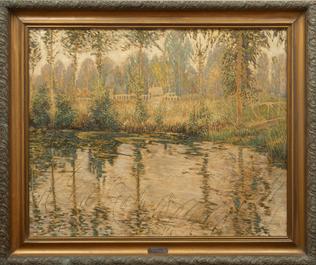
This striking painting, executed in the artist’s distinctive style, emerged from the palette of Václav Radimský, arguably the best-known Czech Impressionist. It was rendered predominantly in muted shades of green and ochre. Within his mature period, this tendency towards monochromaticism represented a certain experiment, or perhaps a reminiscence of his early French works from the late 1880s and early 1890s.
The water dominates the composition, occupying half the picture surface and extending beyond the lower, right and left edges of the canvas. This creates the impression that the artist was standing at the very edge of the bank or painting from a small rowing boat, as he is known to have done frequently. As a passionate fisherman, Radimský was thoroughly at home on the water and drew inspiration in this respect from his most important French Impressionist predecessors, with whom he maintained close personal contact during his stays abroad. The opposite bank is lined with trees; a small bridge is suggested on the right, while beneath a dense stand of mature woodland we can make out a small house and the adjoining line of what appears to be a fence. The artist allows only the faintest glimpses of sky to show through the foliage.
One of the painting’s most remarkable features is its pronounced geometric quality, achieved through Radimský’s favourite painterly device: the principle of reflection. By this means, he projected the vertical lines of the trees onto the surface of the water, dividing the canvas into vertical bands in an original manner and creating a distinctly abstracting effect. Such reflections serve not merely to display painterly virtuosity, but also to suggest that our reality does not always possess just one tangible dimension.
The painting’s appeal to collectors is further confirmed by its inclusion and reproduction in the artist’s most recent monograph and catalogue raisonné (N. Blažíčková-Horová: Václav Radimský, 1867–1946, Řevnice, 2011, cat. No. 235, pp. 160 and 247). Presented in a tasteful period frame. The work was assessed during consultations with Prof. J. Zemina and Mgr. M. Dospěl, Ph.D. An expert opinion by Mgr. P. Kubík is attached.