Ilja Jefimovič Repin (1844–1930)
Ilya Repin, a phenomenal representative of Russian critical realism, is traditionally associated with large, markedly psychological canvases featuring subjects drawn from Russian history (Ivan the Terrible and His Son Ivan on 16 November 1581, 1885; Reply of the Zaporozhian Cossacks to the Sultan Mehmet IV, 1880–1891). His mastery is perhaps best expressed in the art of portraiture. He painted many likenesses of his peers from various strata of society and across the political spectrum (including portraits of Tsar Nicholas II, the writer Tolstoy, and the composer Mussorgsky). The lives of ordinary Russians were a great source of inspiration to him (Barge Haulers on the Volga, 1870–1873; Religious Procession in Kursk Province, 1880–1883; a series of Russian muzhiks) and he depicted them with genuine interest, love and deep understanding. As a result, after the Great October Revolution, he was viewed as one of the greatest models for the Socialist Realism of the 1920s.
Repin was born close to Kharkiv in Imperial Russia (now Ukraine). He studied with a local icon painter and then, after completing preparatory studies in portraiture, left for St. Petersburg and the Imperial Academy of Art (1863–1871), where he was influenced by the painter I. N. Kramskoi and the opinions of the critic and art historian V. V. Stasov. From 1873 to 1876, he lived with his family in Italy and then in Paris at the expense of the Academy. There, he was deeply affected by Impressionism, adopting its approach to light and colour palette while preserving his own style, which was perhaps closer to the European Old Masters. Soon after returning to Russia, he moved to Moscow, where he joined the Society for Travelling Art Exhibitions, a collective of free-thinking artists. He lived in St. Petersburg from 1882 but visited his Ukrainian homeland and occasionally travelled abroad. Stories linked to current events began to appear more frequently in his work, as in the case of the painting They Did Not Expect Him (1884). Indisputably his master work on this theme, the painting combines different psychological states with national motifs from Russia and Ukraine. In 1885, his painting depicting a mad act by Tsar Ivan the Terrible provoked considerable controversy; Tsar Alexander III forbade its exhibition and the painting was even damaged by a religious fanatic in 1913. From 1894 to 1907, Repin was a professor at the Academy in St. Petersburg. During this period, the Russian government commissioned his most grandiose group portrait, Ceremonial Sitting of the State Council, which measures almost nine metres across. The final phase of his artistic life is linked to Kuokkala, Finland, where he was visited by Russian intellectuals and friends (M. Gorky, V. Stasov, A. Kuprin, K. Chukovsky).
Items of the author
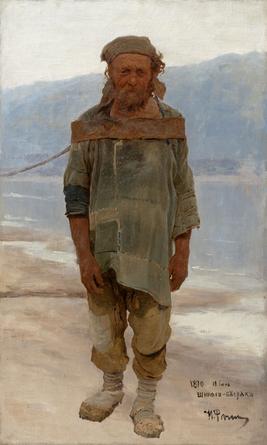
1,300,000 CZK
Final price:
12,480,000 CZK
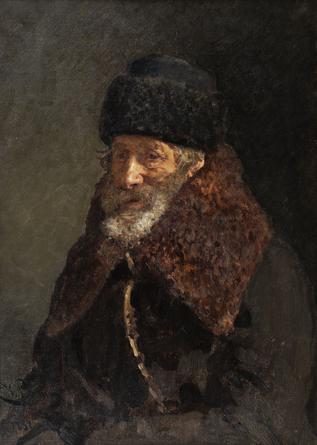
2,900,000 CZK
Final price:
4,920,000 CZK
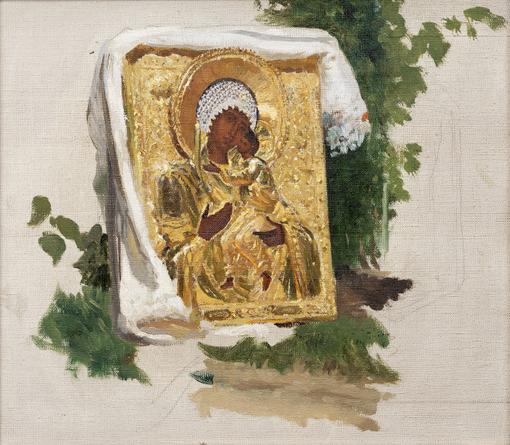
350,000 CZK
Final price:
840,000 CZK