oil on wood panel
1935
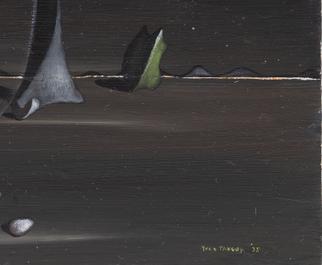
lower right
35 × 45.5 cm
framed
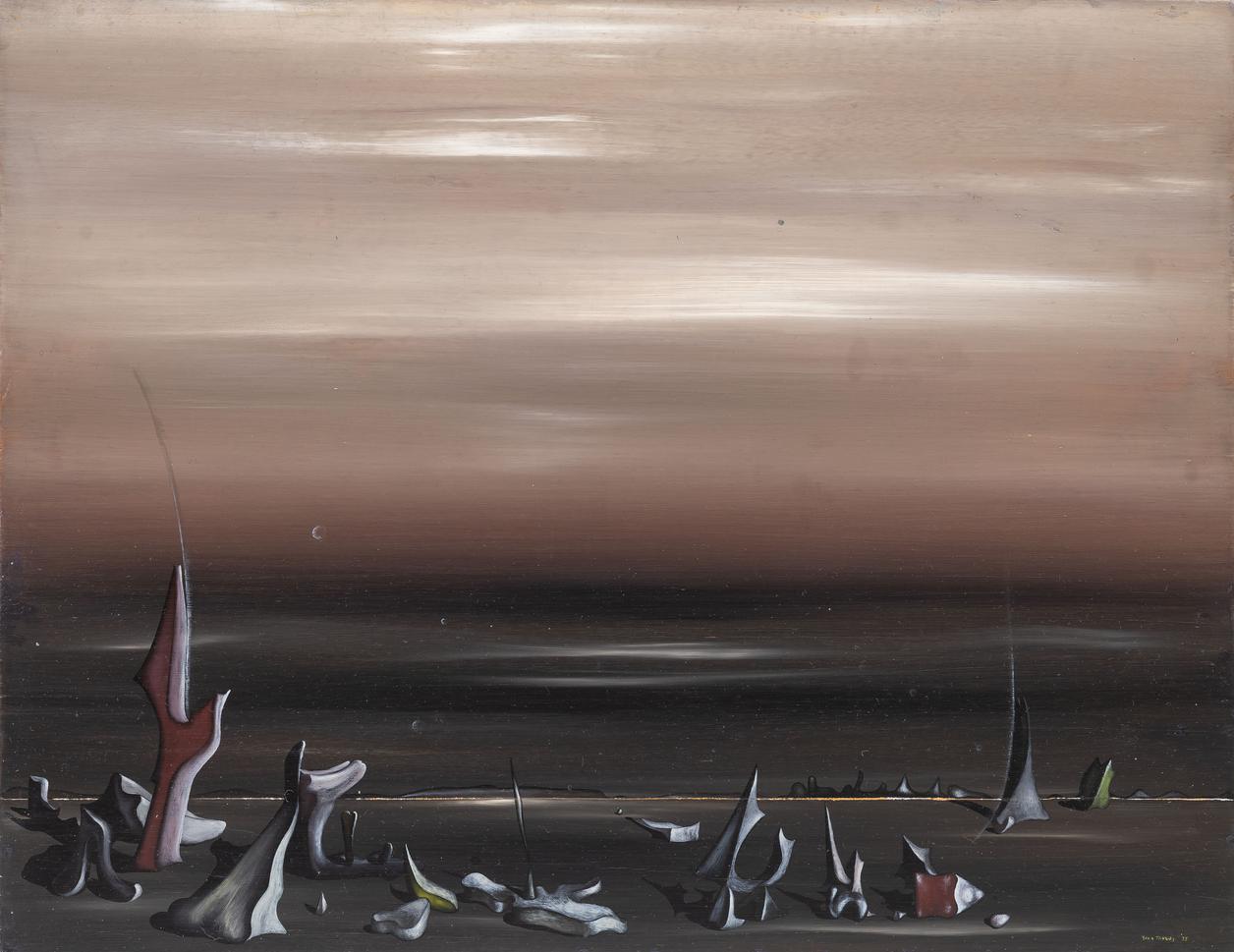
This mysterious Landscape is an exceptionally rare and captivating example from the high period of French Surrealism, and therefore represents an outstanding opportunity for collectors. Its creator, Yves Tanguy, was among the most important members of the Parisian Surrealist group, which he joined in 1926 and whose leader, André Breton, remained his lifelong friend. Breton aptly described him as: “Yves Tanguy, painter of captivating aerial, subterranean and maritime elegances… my beloved friend.”
Tanguy’s path to painting was inspired by his encounter with The Child’s Brain from the metaphysical period of Giorgio de Chirico, which awakened in him a fascination with mysterious spaces and enigmatic objects. At his first exhibition in the Galerie Surréaliste in 1927, he already presented imaginary landscapes populated by biomorphic forms casting dramatic shadows. The titles of his paintings were selected from a psychiatry textbook. Over time, his motifs evolved into characteristic compositions featuring endless horizons and strange forms dispersed across open space. During this period, Tanguy’s imagination was shaped not only by journeys to the beloved Celtic region of Brittany around Locronan, where his mother lived, but also by exhibitions of contemporaries in Parisian galleries – for example, those of Hans Arp at the Galerie Surréaliste and Jindřich Štyrský and Toyen at the Galerie Vavin-Raspail at the turn of 1928 and 1929.
A decisive transformation in Tanguy’s style came with his journey to North Africa in 1930. His paintings became inhabited by barren, almost endless landscapes populated with petrified or levitating structures resembling eroded rocks or prehistoric monoliths. From the mid-1930s onwards, the originally soft biomorphic forms evolved into firmer, skeletal structures arranged in space like a silent procession.
In the present Landscape, bearing the artist’s title La qualité du pain (The Quality of Bread), these polymorphic structures are scattered across a grey-brown plain over which stretches a translucent atmosphere and softly luminous sky. The foreground objects resemble rocks, bones, fossils or fantastical organisms, casting long shadows that emphasise the depth of space. Such visions undoubtedly evoke memories of the megalithic fields of Finistère shrouded in a misty, unreal atmosphere. The precision of the painterly execution and the almost photographic sharpness of detail place Tanguy, together with Salvador Dalí and René Magritte, among the so-called veristic branch of Surrealism, whose aim was to depict the world of dreams with maximum illusionistic precision.
The atmosphere of the painting also reflects the tensions of the mid-1930s. The desolate landscape, monotonous palette and isolated forms create the impression of an oppressive, almost apocalyptic vision. Tanguy thus created a scene without clear boundaries or points of orientation, in which the individual objects are anchored only by their shadows. Yet his work never approached abstraction, as confirmed by his close friend Jacques Hérold: “He was never abstract; he could not be abstract. In these landscapes with horizons, which in reality had neither horizon nor boundaries, the shadows were present in order to anchor the objects to the ground and to lend them reality and solidity.”
The work is of an exceptionally interesting provenance. In June 1935, the Czech artists Toyen, Jindřich Štyrský and Vítězslav Nezval visited Paris in order to meet their French Surrealist friends and to attend the Congress of Writers for the Defence of Culture. Among the artists they encountered during their stay were, in addition to André Breton and Paul Éluard, also Benjamin Péret, Yves Tanguy, Max Ernst, Salvador Dalí, Claude Cahun, Joan Miró, Man Ray and other representatives of Parisian Surrealism. Nezval wrote about this visit in his book Gît-le-coeur; as a keepsake, both he and Toyen received small watercolours from Yves Tanguy. On this occasion, Toyen also acquired the painting Landscape and brought it back to Czechoslovakia.
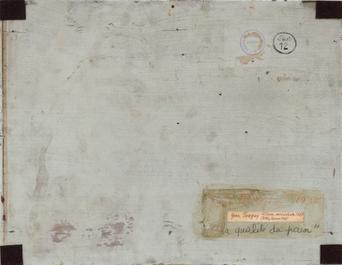
The work subsequently entered the collection of Josef Janda, physician, legionnaire, journalist, translator from Russian and patron of avant-garde painters and poets, whom Nezval mentioned in his memoirs. He is also recorded in the dictionary Československo-biografie, compiled between 1936 and 1941, which states: “Janda Josef, MUDr., specialist in dermatovenerology and cosmetics […] owner of paintings by E. Filla, J. Král, J. Štyrský, Y. Tanguy, Tichý, Toyen, J. Šíma.” Janda later exchanged the work with JUDr. František Čeřovský, as documented by the inventory record of his collection. On the reverse of the painting appears the circular purple stamp of the Čeřovský Collection with the number 12, corresponding to the work’s inventory card. The artist’s title La qualité du pain, inscribed on the reverse of the painting, is also recorded there.
The work was presented at the exhibition French Modern Painting, organised by SVU Mánes in Prague (12 June – 7 July 1946), where it appeared under catalogue No. 14 and the title Landscape. It was examined in consultation with Mgr. K. Guth-Vladaj, PhD, and doc. M. Theinhardt.
Quotations from expert reports:
PhDr. K. Srp: “[…] The relationship between the biomorphic forms and the infinite space is emphasised in this painting by the introduction of a thin, sharp, luminous horizon line in the lower half of the canvas, dividing the field upon which the objects are situated into two parts and accenting the irrationality of the entire scene. Such elements of linearity were characteristic precisely of Yves Tanguy’s paintings from the mid-1930s. Although the painting was simply titled ‘Landscape’, the artist’s original title has survived in this case, as was most likely true of all the paintings Tanguy included in his second exhibition. […]”
Prof. J. D. Ades, CBE, FBA: „[...] While instantly recognisable as a painting by Tanguy, Landscape has special features that lock it into a very interesting period: the surrealists’ fascination with the object in the 1930s, which Tanguy shared. [...] Tanguy’s horizons were always fascinating and mysterious, standing out ‘as a sharply defined line in almost all his paintings’ as the surrealist leader André Breton wrote, but which he never explained, ‘revealing nothing of his intentions and disdaining to refute those attributed to him.’ But they become, for a time, as here, more emphatic and also ambiguous. [...]“