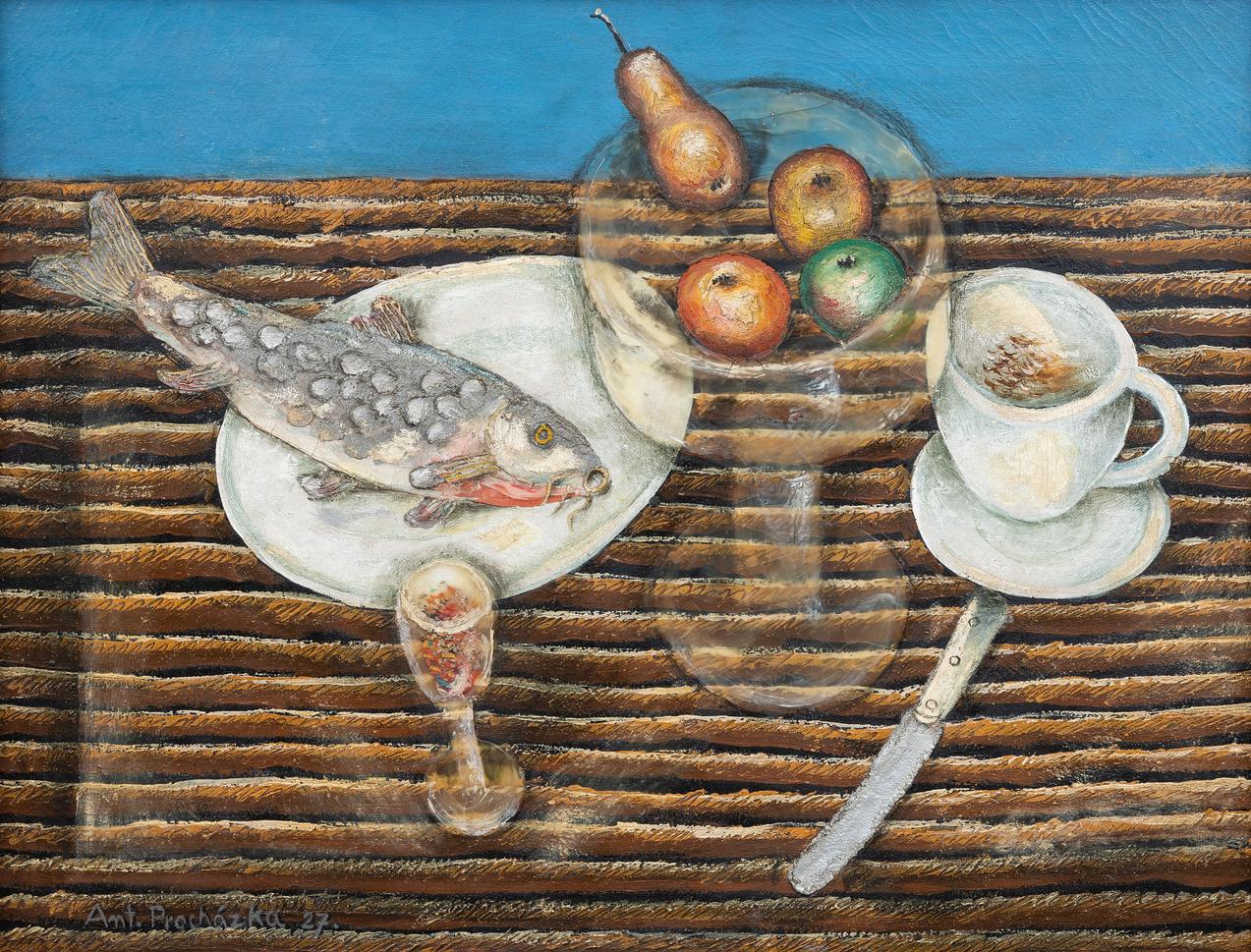
encaustic on canvas
1927
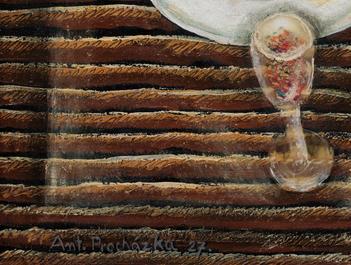
lower left
50 × 65 cm
framed
The year 1927 represents a period of stylistic consolidation in the work of Antonín Procházka, when he finally moved beyond the Cubist distortions of his earlier work and focused instead on synthesising modern stylisation with a neoclassical clarity of form. This was also a period in which he was prominently represented on the exhibition scene. He participated in members’ exhibitions of the Group of Fine Artists in Brno and the Mánes Association of Fine Artists, and his works were also presented at an international exhibition of contemporary European art in Hamburg.
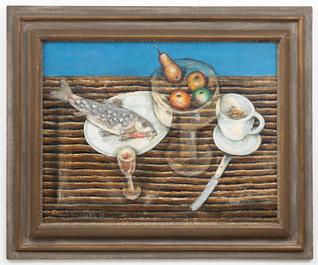
Procházka’s still lifes from this period are characterised by clearly identifiable objects arranged within a shallow pictorial space, often placed upon a tabletop with a distinctive decorative backdrop. Motifs of everyday dining – fruit bowls, glasses, jugs and bottles – became carriers of a calm and harmonious atmosphere. Glass Tray and a Fish thus represents one of the characteristic works of this phase. The composition depicts a modestly arranged tabletop scene and a serene, balanced structure. Resting against a horizontally rhythmical striped background are a plate with a fish, a bowl of fruit, a porcelain cup, a knife and a glass of wine.
A particularly important expressive element here is encaustic painting – a technique employing pigment mixed with wax. According to contemporary accounts, Procházka systematically developed this method from the mid-1920s onwards, as it fully corresponded with his efforts to unite modern expression with durability and a sense of material substance in painting. The relief-like character of the paint layers and the distinctive, almost mysterious light emerging from the wax surface lent his works an impression of permanence and timeless calm, reflecting his contemporary intellectual considerations concerning stable order and the continuity of tradition within modern art.
The painting’s surface acquires striking tactile qualities: the fish scales, the texture of the table and the modelling of the fruit are constructed through rich layers of paint rising above the picture plane. This material quality lends the composition an exceptional vitality, luminous depth and an almost sculptural modelling of the individual objects.
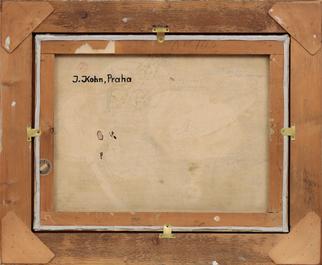
The present work represents a remarkable example of the artist’s mature production from the second half of the 1920s, characterised by compositional balance, a refined colour palette and a pronounced sense of materiality. The painting was exhibited at a joint exhibition of Emil Filla and Antonín Procházka (Comprehensive Exhibition of Paintings, Künstlerhaus, Brno, 1932), and later at the Comprehensive Exhibition of the Work of Antonín Procházka organised by the Mánes Association in Prague in 1934, as documented by the stamp on the reverse of the canvas identifying the exhibition (SVU Mánes, Prague, 15 March–4 April 1934, cat. No. 110). The introductory text to the accompanying catalogue was written by Vincenc Kramář.
The work originally formed part of the important interwar collection of František Venera. During consultations, it was assessed by Prof. J. Zemina and Ing. V. Bartoš. An expert opinion of PhDr. R. Michalová, PhD, accompanies the work, including the following observation: “Antonín Procházka constructed this still life according to the exceptionally effective principle of a ‘shop window’, allowing the viewer the unique opportunity truly to savour each object visually.”