oil on canvas
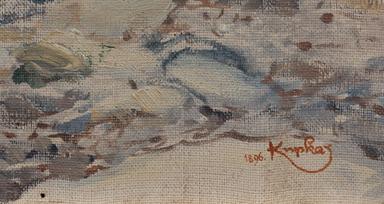
1896
lower right
27 × 41 cm
framed
František Kupka possessed exceptional talent, which he cultivated at the academies in Prague and Vienna under František Sequens and August Eisenmenger respectively. Even during his studies, he established himself as a skilled and versatile artist. He was also widely read, with a broad range of intellectual interests. Paris played a decisive role in his artistic development: he settled there at the turn of 1895–1896 and remained closely associated with the city for the rest of his life. The early Paris years were a restless period of exploration, both personally and artistically. In this European artistic capital, he first had to come to terms with the legacy of several earlier artistic movements. Alongside the crucial influence of Symbolism, he also drew on the tradition of Impressionist plein-air painting, which found expression in his work through a relatively dense, tactile handling of paint and fresh colours. He employed these qualities in the celebrated composition from this period known as Biblioman (oil on canvas, 1897, 94 × 151 cm, Prague Castle Collections).
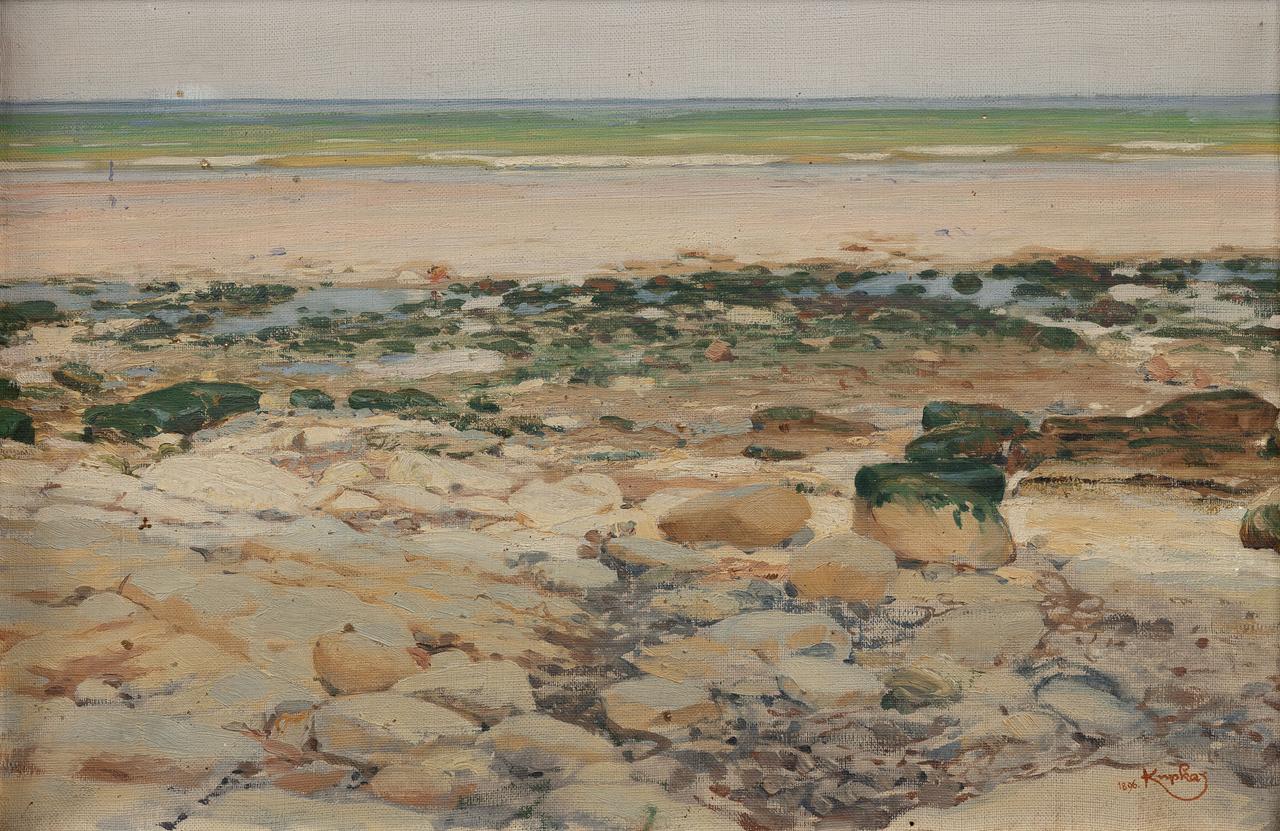
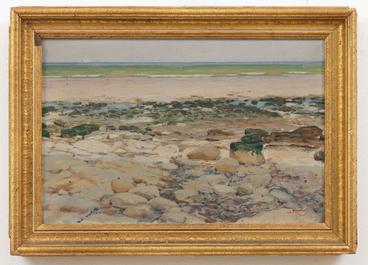
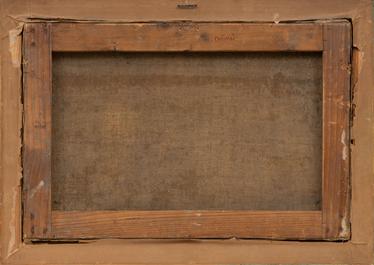
The painting presented here also dates from this period. A small-scale work with a pronounced horizontal composition, it depicts a beach at Onival in France, as indicated by an inscription on the reverse of the stretcher. The foreground is occupied by a stony shoreline scattered with boulders and pebbles of various sizes, probably exposed at low tide. Further into the distance, the stones give way to a strip of sandy beach, while the background is dominated by the expanse of sea, bounded by the horizon. The cloudless sky is confined to a narrow strip, occupying only a minimal area of the composition. The paint handling is remarkably light and intuitive, making use of the ground’s colour and applied in a dynamic manner without preparatory drawing. The painting was therefore very probably executed en plein air, directly on one of the beaches at Onival. Situated within easy reach of Paris, this location attracted numerous artists, including many of Czech origin. Kupka is known to have visited the area, as evidenced, for example, by the correspondence of the painter and printmaker Tavík František Šimon, who met Kupka there later, in the spring of 1904.
Although this subject is unusual within Kupka’s oeuvre, it is not unique. The painting is exceptionally rare and highly appealing to collectors, offering an opportunity to deepen our understanding of the artist’s early work during his formative period, shortly after settling in Paris. It was published in the 2016 catalogue raisonné of Kupka’s oil paintings (cat. No. 13, p. 66). It was assessed during consultations with Prof. M. Theinhardt, CSc, and P. Brullé. An expert opinion by PhDr. K. Srp is attached.